
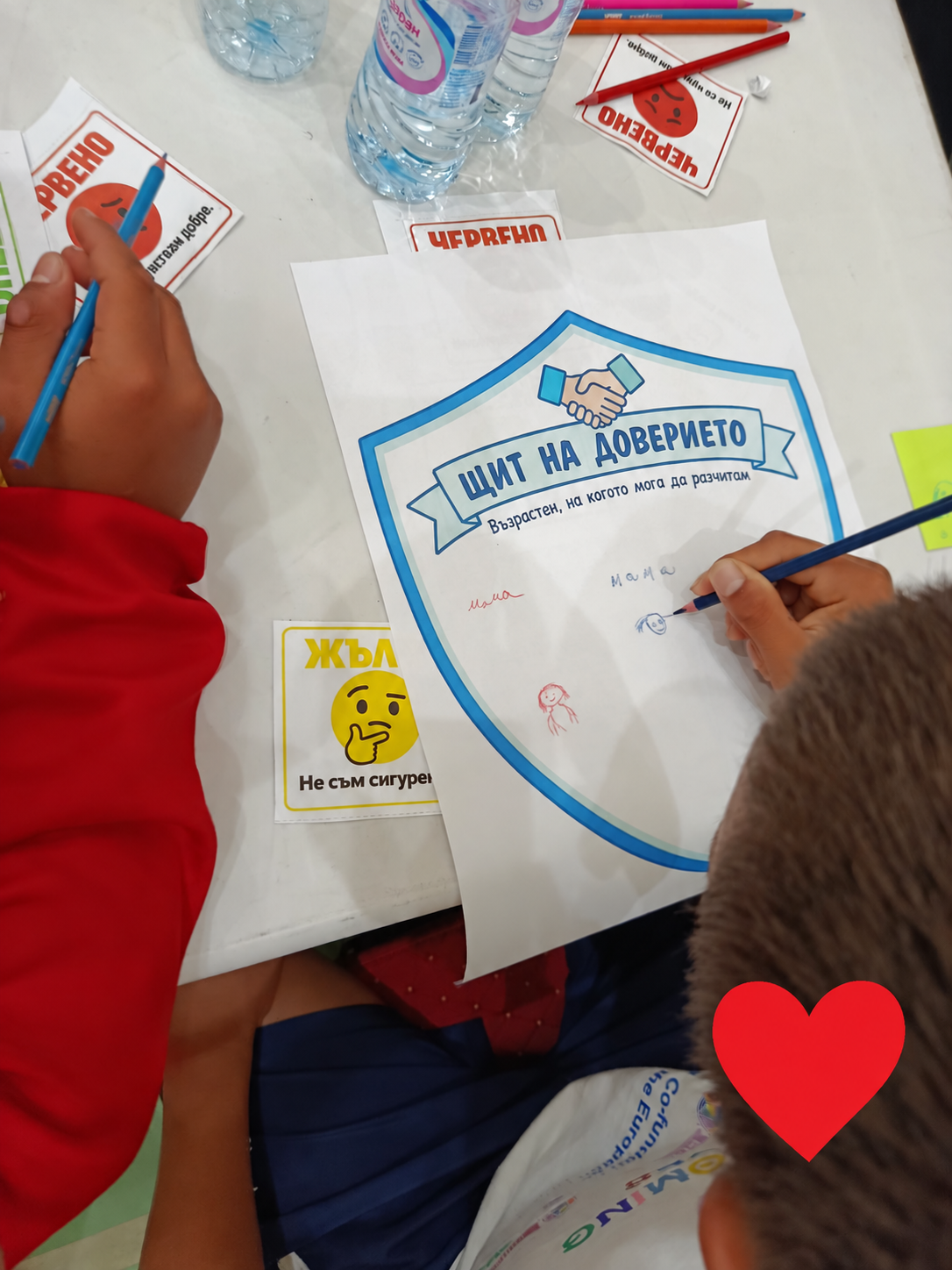
On 13 September 2026, the Bulgarian Sports Federation for Children and Youth at Risk organised a dedicated co-creation session with 21 children as part of the European 360° Safe Play project.
The session was designed as an interactive activity in which children could participate in different ways — through discussion, colours, cards, drawings and small-group work. This reflects the core approach of the Children’s Workshop methodology, which places children’s own perspectives at the centre of discussions about safety in sport.
When does sport feel good?
At the beginning of the session, children were invited to show or describe what makes sport feel enjoyable and safe.
Some of the strongest themes were respect between teammates, a friendly environment and feeling part of a team.
Travelling to competitions was also seen positively by many participants because it gives them more time to talk, communicate and build friendships.
Green, yellow or red?
Using traffic-light cards, children reflected on different situations from everyday sport.
🟢 green – I feel good;
🟡 yellow – I am not sure;
🔴 red – I do not feel good.
Online teasing and situations where a child needs to tell an adult that something feels wrong were among the moments associated with greater uncertainty or discomfort.
One message became particularly clear: authority alone does not create trust. Children are more likely to speak when the adult is someone they genuinely trust.
Who do children turn to?
When discussing different fictional situations, children most often identified a trusted teacher or their coach as the person they would approach.
This was particularly relevant for this group of participants. For many of them, these adults represent some of the most accessible and trusted sources of support.
In conflicts between peers, children also said that they would generally avoid intervening themselves and instead ask an adult — usually a teacher or coach — to help resolve the situation.
The Trust Shield
One of the most engaging activities was the “Trust Shield”.
Children were invited to write or draw what a trusted adult looks like to them.
Their responses strongly highlighted the role of a coach who:
- is patient when children make mistakes;
- teaches discipline;
- encourages healthy habits;
- communicates calmly;
- supports rather than humiliates;
- helps children feel that they belong to the team.
These are the qualities children expect from coaches and from their sports clubs.
“If I could change one thing…”
At the end of the session, each child had the opportunity to anonymously write or draw one thing they would like to change.
Their responses included wishes for:
fewer negative people around them;
not being labelled as “bad” or “incapable”;
people treating each other better.
For some participants, writing was difficult, and drawing or other forms of expression were easier. This is precisely why the 360° Safe Play methodology allows children to participate through words, drawings, symbols and visual choices, rather than requiring written responses.
Making children’s voices part of the solution
Not all participants were able to maintain concentration throughout the full session, and some chose to leave earlier. This was respected as part of the voluntary nature of participation and highlighted the importance of adapting future activities to different ages, communication styles and learning needs.
The most important message, however, was clear:
Children are able to tell us what helps them feel safe — when we give them the right way to express it.
Their perspectives, together with those of coaches and parents, will contribute to the development of practical tools and solutions under 360° Safe Play, supporting safer, more respectful and more inclusive sporting environments for all children.


